Free · by Timothy Gaull
The AI Foundation Kit
Get how your business actually runs out of your head and into something AI can use. You don't have to write it. The kit has AI interview you for it.
Your download has started.
If it didn't, download the kit here. The link works for 15 minutes.
Using Claude? Turn on Code execution (Settings, then Capabilities). Then upload the zip as it is: Customize, then Skills, then Upload a skill. Start a chat and say “Start the AI Foundation interview.”
Using ChatGPT, Gemini or another AI? Copy the whole kit as one message and paste it into a new chat. Step-by-step with pictures ↓
Did this save you time? The kit is free. If it helps, you can tip whatever feels right.
Thank you. Tips like yours keep the kit free for the next owner.
Want help running it? See how we’d work together.
Free to use and share under CC BY 4.0.
How it works
How work moves through any business
Every business has a version of this. The kit maps yours by interviewing you about one real, finished job, then tags each stage by the kind of work it takes. Pick your business to see it in your terms.
- Mechanical: AI can run it
- Hybrid: AI drafts, you sign off
- Judgment: Stays with a person
- Hybride.g. A quote request by email
Request comes in
Log it, check the basics
- Judgmente.g. A site visit
Qualify
Is this work we want?
DeclinedLogged with the reason and date - Hybride.g. Measurements and photos
Scope
What exactly is the job?
- Hybride.g. An estimate
Price
What will it cost and earn?
LostThe quote didn’t win - Mechanicale.g. A signed quote and deposit
Commit
Signed, deposit in
- Judgmente.g. Build and install
Deliver
Do the work well
- Mechanicale.g. The final invoice
Get paid
Bill, collect, follow up
What changes
What happens to each stage
The tag on each stage decides its future. Routine stages become skills your AI runs. The calls only you can make stay with you.
- Hybrid
Request comes in
Log it, check the basics
Skill + your OKAI drafts, you approve - Judgment
Qualify
Is this work we want?
YouYour call, now written down - Hybrid
Scope
What exactly is the job?
Skill + your OKAI drafts, you approve - Hybrid
Price
What will it cost and earn?
Skill + your OKAI drafts, you approve - Mechanical
Commit
Signed, deposit in
SkillRuns on its own - Judgment
Deliver
Do the work well
YouYour call, now written down - Mechanical
Get paid
Bill, collect, follow up
SkillRuns on its own
2 stages run as skills
Written once, tested on your past decisions, checked every week. You stop doing them by hand.
3 stages get a skill and your sign-off
The AI does the legwork. You make the one decision inside it and approve.
2 stages stay with you
The map records what you look at and why, so your calls get faster, and one day teachable.
Why it compounds
Good work feeds the next job
Each stage hands its output to the next, and the last one asks for the review that brings in the next request.
- Hybrid: Request comes in
- Judgment: Qualify
- Hybrid: Price
- Mechanical: Commit
- Judgment: Deliver
- Mechanical: Get paid
- Mechanical: Ask for a review
Reviews bring the next request
Each stage feeds the next
The output of one stage is the input of the next: a request becomes a qualified job, then a price, then a signed commitment. That is how skills chain together.
The routine stages keep turning
Commit, get paid and ask for a review run as skills, so the loop keeps moving while you are on the job.
Close the loop on purpose
The review request is one small skill. It feeds the top of the loop, where new customers find you.
Why it works
You can't automate what isn't written down.
Most AI adoption stalls for the same reason. The tools are fine, but every chat starts cold, because the real process, the pricing rules and the judgment calls live in the owner's head. This kit builds that missing foundation first, then turns it into AI skills one at a time.
Every week, steps 3 and 4 repeat
Map
Two or three 45-minute interviews about real, finished work.
You getA stage-by-stage mapContext
What you carry in your head, written down once: what you take on, your pricing assumptions, what done means.
You getA context packSkills
Your busiest routine stage becomes a skill, tested on five of your own past decisions before anyone trusts it.
You getA tested skillBank corrections
Every week, each place a skill got it wrong becomes one dated edit.
You getA log that proves it improvesTeach
New hires make the call first, then compare it with the skill’s reasoning.
You getA team that learns your judgment
In practice
The bottleneck is rarely the people
Three real projects. Each fix moved routine work into a simple tool the team already uses, and gave their time back to the work that needs them.
A fabrication shop
Calls missed while the owner is on a job site in the busy season.
A request form and a virtual assistant catch leads while the owner is on site. He calls back the ones worth quoting.
Owner’s time goes to site visits and accurate estimates.
An animal rescue
Adoption applications on paper, and paper gets lost.
Volunteers list pets from their phones, and applications arrive complete, online.
Volunteer time goes to the animals.
A global sales team
Years of client relationships kept in private spreadsheets, off the system.
A relationship stage with no pressure to close, so the whole picture is finally visible.
Advisors’ time goes to the relationships.
What's inside
Six plain files, plus a Claude Skill.
Everything is plain text, so it works in any AI tool today and in whatever you use in two years.
01 · Service delivery map
The interview. The AI asks you one question at a time about real jobs you have done, and writes down how work actually moves through your business, stage by stage.
02 · Context pack
The facts every stage assumes but nobody wrote down: what you take on and what you turn away, your standing assumptions, your shorthand, what “done” means.
03 · Skill extraction
Turns one mapped task into a written skill an AI can run and a new hire can learn from, in one fixed format so skills chain together.
04 · Example: quote request triage
A fictional worked example for a small fabrication shop, showing what a draft skill looks like, holes and all.
05 · Verification and retro
How to test a skill against five of your own past decisions before you trust it, and the 15-minute weekly habit that makes it better.
06 · Example: deal intake
A second fictional example, for a real estate investor screening new deals.
How to start
Which AI do you use?
Pick yours. Each way takes about two minutes, and the kit runs on your own account, so your business details stay with you.
Turn on code execution
In Claude, open Settings, then Capabilities, and switch on Code execution and file creation. Skills need it.

Upload the zip as it is
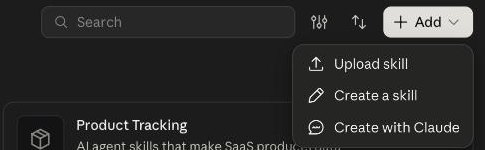
Open Customize, then Skills. Click Add, then Upload skill, and choose the zip you downloaded. Don’t unzip it.
Check it’s there
You’ll see ai-foundation-kit with its switch on. Click Try in chat, or start any new chat.

Start the interview
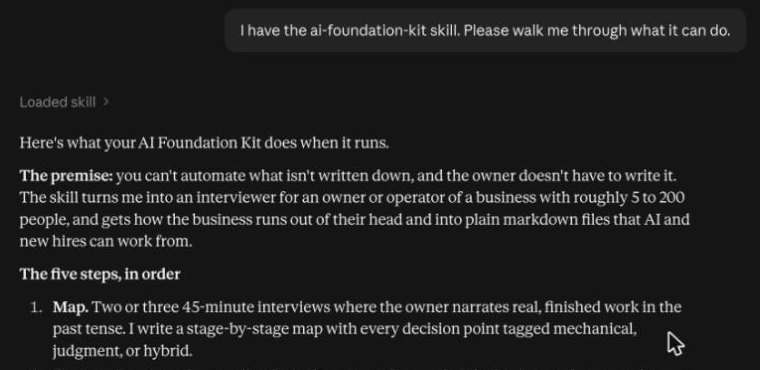
Say “Start the AI Foundation interview.” Claude loads the kit and asks one question at a time. Stop anytime; next time, say “Let’s keep going.”
Get the kit
Enter your email above. The starter prompt comes with your download.
Copy the starter prompt
It’s the whole kit as one message: the instructions and all six guides.
Paste it into a new chat
Open a new chat in ChatGPT, Gemini, Copilot or any AI tool, paste, and press Enter. If your tool says the message is too long, use “download it as one file” and attach the file instead.
Answer one question at a time
Keep the same chat for your next session so it remembers what you’ve covered.
Unzip it into your skills folder
Put the
ai-foundation-kitfolder in~/.claude/skills/, or in your project’s.claude/skills/.Start the interview
In Claude Code, say “Start the AI Foundation interview.” It writes the map and context pack as markdown files in your project.
Stuck, or want someone to run it with you? See how we’d work together →
A preview
The eight rules the AI interviewer follows.
These come straight from file 01. They're what make the difference between a useful map of your business and a generic chat.
- One question at a time. The AI waits for your answer. It never sends a list of questions.
- Real work, past tense. "Walk me through the job you finished last month" gets the truth. "What's your process?" gets the version nobody follows.
- Stop at every soft verb. When you say "I look at it and decide," that's hidden judgment. The AI asks what you looked at first and what would have changed your answer.
- Numbers, word for word. Prices, thresholds, lead times and limits are written down exactly as you say them.
- Ask for the exception. Every rule gets a follow-up: "When do you break that?" The exceptions are where the expertise lives.
- Never invent. Anything the AI inferred rather than heard is marked [UNCONFIRMED]. A visible hole beats a hidden guess.
- Record first, improve later. Fixes go in a separate list, so you describe the process instead of defending it.
- 45 minutes, then stop. Tired answers are vague, and vague answers make bad AI skills.
Questions
Common questions
What is the AI Foundation Kit?
A free set of plain-text files that turns any AI chat tool into an interviewer. It asks a business owner how work actually moves through the business, writes down the rules and numbers only the owner knows, and turns the most repetitive task into a tested AI skill.
Who is it for?
Owners and operators of businesses from one person up to roughly 200, such as trades, shops, manufacturers, professional services firms and real estate investors, where most decisions still run through the owner.
How do I teach AI how my business works?
Write down what only you know, then give it to the AI every time. The kit does this by interviewing you: it maps how work moves through the business, collects standing facts like what you take on and turn away, pricing assumptions and approval gates, and turns one recurring task into a skill that is checked against five past decisions before you trust it.
Which AI tools does it work with?
Claude, ChatGPT, Gemini, Copilot or any AI chat tool that accepts a long message. In Claude it also installs as a skill.
What does it cost?
Nothing. It is licensed CC BY 4.0, so you can use, adapt and share it, including with clients, as long as you credit Timothy Gaull.
How long does it take?
Two or three 45-minute interview sessions produce the first map. Most owners have a first tested skill within a few weeks.
Why do you ask for my email?
To keep the download from being scraped. If you check the box, you'll also get the follow-up on how owners are using their first AI skill, plus occasional notes. Your email is never sold or shared, and you can unsubscribe anytime.