WorkAllianceBernstein · asset management
AllianceBernstein: 6,000 people off paper
AllianceBernstein, a global asset manager, ran on printing, filing and routing paper. I led the program that moved 3,500 employees and 2,500 contractors onto iPads and digital workflows, and designed and built the app that taught them how.
- Role
- AVP, User Experience Lead
- Scale
- 3,500 employees and 2,500 contractors
- Result
- An estimated $10M a year in savings
- Years
- 2017 to 2021
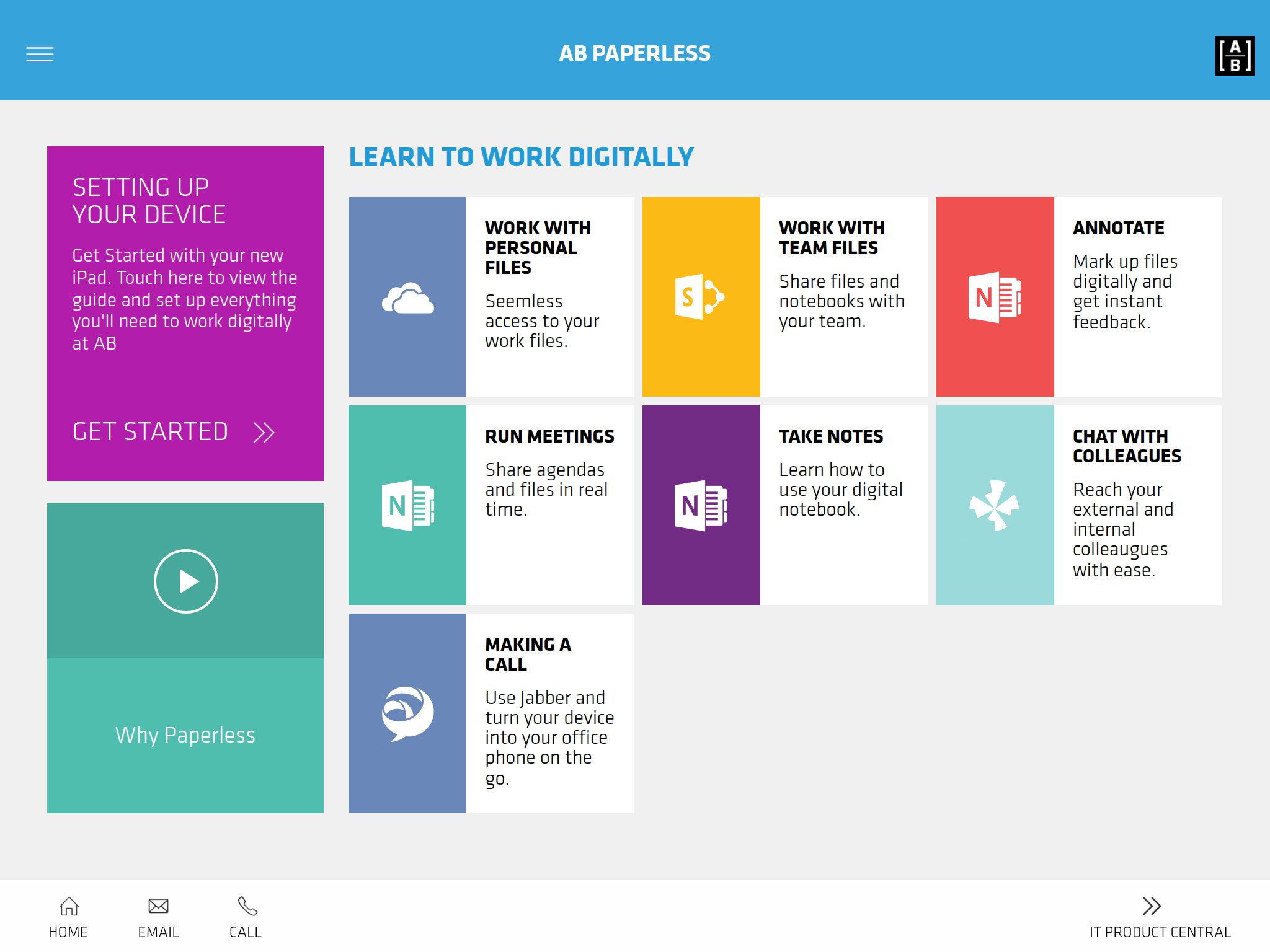
Printed, filed and routed by handAB Paperless, the iPad app that taught people to work digitally
Before
Thousands of people did their daily work on paper.
Documents were printed, filed and routed by hand across offices worldwide. It was slow and expensive, and in a regulated business, paper is a compliance risk.
Buying document software was the easy part. The hard part was changing how thousands of people did their work, across teams that each handled documents their own way.
The approach
How do you get people to adopt new technology?
Start with the work, not the software. Change management for a technology rollout comes down to four habits, and the paperless program used all of them.
Study the real work
Before anyone chose tools, I studied how teams actually handled documents, so the new workflows fit the work instead of the org chart.
Design the workflows
Digital ways to do the same jobs people already did: keep files, share them, mark them up, run a meeting, take notes, call a colleague.
Teach the job, not the tool
Training was named for the task, like “Annotate” or “Run meetings”, and then showed which app does it, in a short video and a step-by-step walkthrough.
Keep help one tap away
Email, call and IT Product Central sat at the bottom of every screen, so nobody got stuck on their own.
AB Paperless
An app that teaches the job, not the software
I designed and built AB Paperless, an iPad app for everyone setting up a new iPad. It walked people through setting up, then taught each task with a short video and an animated walkthrough. It shipped and kept improving through version 1.5.
Learn to work digitally
- Work with personal files
- Work with team files
- Annotate
- Run meetings
- Take notes
- Chat with colleagues
- Make a call
Set up your device
- PingID
- OneDrive
- SharePoint
- OneNote
- Office apps
- Symphony
- Jabber
IT Product Central
Every tool, its guide and its training in one place
The app's last button opened IT Product Central, an intranet site I designed and built on WordPress. Each product had its own page, its guides and training sessions people could sign up for, and it was built on a shared design system I made with the firm's developer and UX guilds, so new internal tools looked and behaved the same from the start.
What changed
Paper out, new habits in
- 6,000
- people moved onto digital workflows: 3,500 employees and 2,500 contractors
- ~$10M
- a year in estimated savings
- 5,500+
- employees worldwide later used the digital training tools that grew out of this approach
The software was the easy part. Adoption was the hard part.
Why it matters for your business
Tools don't change a business. New habits do.
AI works the same way. Every AI rollout I run now starts where this one did: with how the work really happens, and with the people who do it. The free AI Foundation Kit starts there too.
Later at AllianceBernstein I did the same for institutional sales: mapping the sale and redesigning the CRM around how advisors actually work.
Next step